
Glass Cleaning
The Cover Glass Cleaning for Surface appearance and process consistency improvement
Glass cleaning plays an essential role at every stage of cover glass production. It is used to eliminate particulates, grease, grinding chips, and residual surface contaminants prior to crucial operations including printing, coating, lamination, inspection, and packaging.
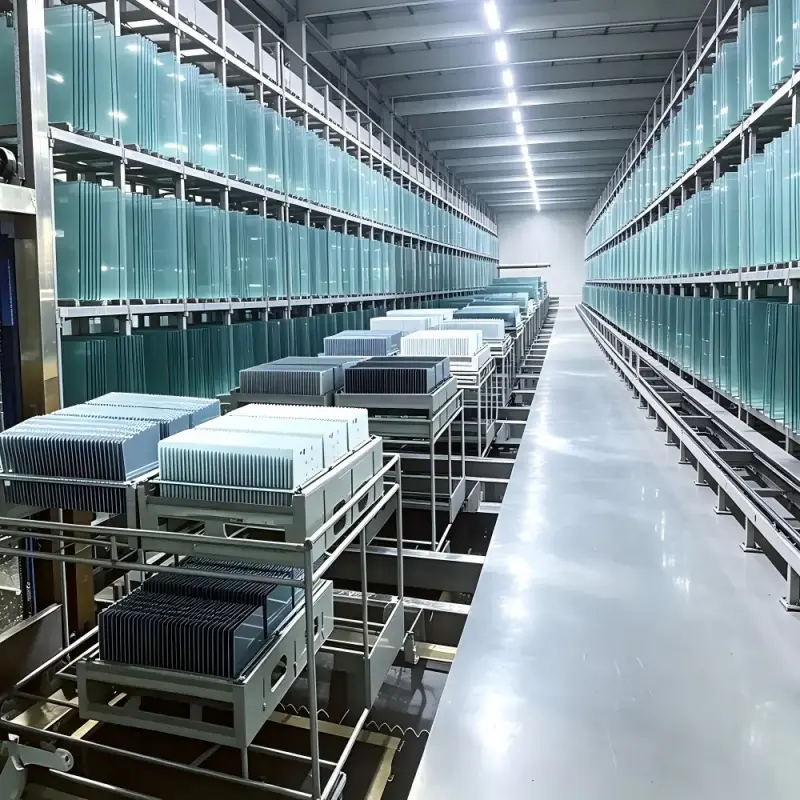
The definition of glass cleaning in cover glass lens manufacturing
Cover glass production involves a precisely managed cleaning step that eliminates dust, particulates, oil, polishing compounds and other contaminants from the glass surface at various fabrication stages. This step ensures the glass is properly prepared for critical downstream operations, including silk screen printing, AG/AR/AF coatings, lamination, inspection and packaging.
Industrial glass cleaning differs from ordinary cleaning methods in that it is tightly linked to process control, product quality, and manufacturing efficiency. For cover glass applied in industrial displays, medical devices, smart home panels, and electronic equipment, the level of surface cleanliness has a direct impact on both final performance and appearance.
Why Cleaning Is Essential at Every Stage of Cover Glass Fabrication
Throughout cover glass production, cleaning must be carried out at numerous points, including cutting, CNC machining, polishing, tempering, silk-screen printing, surface coating, OCA lamination/tape bonding, quality inspection and packaging. At each of these steps, contaminants such as glass fragments, dust, oil, fingerprints, powder, and chemical residues may accumulate on the surface and disrupt subsequent operations.
Effective cleaning serves to ready the glass for the following production stage, enhance surface quality, promote stronger adhesion and coating results, lower the likelihood of defects and contribute to consistent manufacturing output. This is precisely why cleaning represents a vital element of quality assurance in custom cover glass fabrication.
Cleaning Goals Across Key Production Stages
| Process Stage | Primary Cleaning Objective | Quality Impact |
|---|---|---|
| After CNC Machining | Eliminate glass chips, abrasive remnants, and oil left behind by CNC operations | Helps prevent scratches on the glass surface |
| After Edge Polishing | Eliminate polishing powder and fine surface debris | Helps lower the risk of tempering defects, reaction marks, dents, and other cosmetic problems |
| After Tempering | Eliminate residual compounds left on the glass surface following tempering | Helps maintain a clean surface for downstream processing |
| Before Silk-Screen Printing | Eliminate oil, dust, and surface debris | Helps enhance ink appearance and adhesion |
| After Silk-Screen Printing | Eliminate powder, residue, and contamination introduced after processing | Helps ready the glass for the next production step |
| Before Coating | Eliminate oil, dust, and surface contaminants | Helps improve coating uniformity and adhesion |
| After Coating | Eliminate oil stains, powder, and leftover residue | Helps minimize appearance defects such as contamination marks and white spots |
Typical Contaminants on Cover Glass Surfaces
Various contaminants can be left on the glass surface during manufacturing including:
- Cutting oil and fluid remnants
- Grinding dust and edge debris
- Polishing powder and residue
- Fingerprints and handling marks
- Fine particles introduced during transfer
- Water marks and washing residue
Although these contaminants may appear insignificant, they are capable of causing visible defects, compromising coating uniformity, weakening print adhesion or diminishing the overall surface quality of the glass panel.
Cover Glass Cleaning Technologies
The choice of cleaning method for cover glass depends on factors such as product size, surface condition and the requirements of downstream processes. In actual production, ultrasonic cleaning and flat brush water cleaning each play distinct roles and can be used in combination to achieve greater efficiency and process stability.
ultrasonic cleaning against flat brush water cleaning
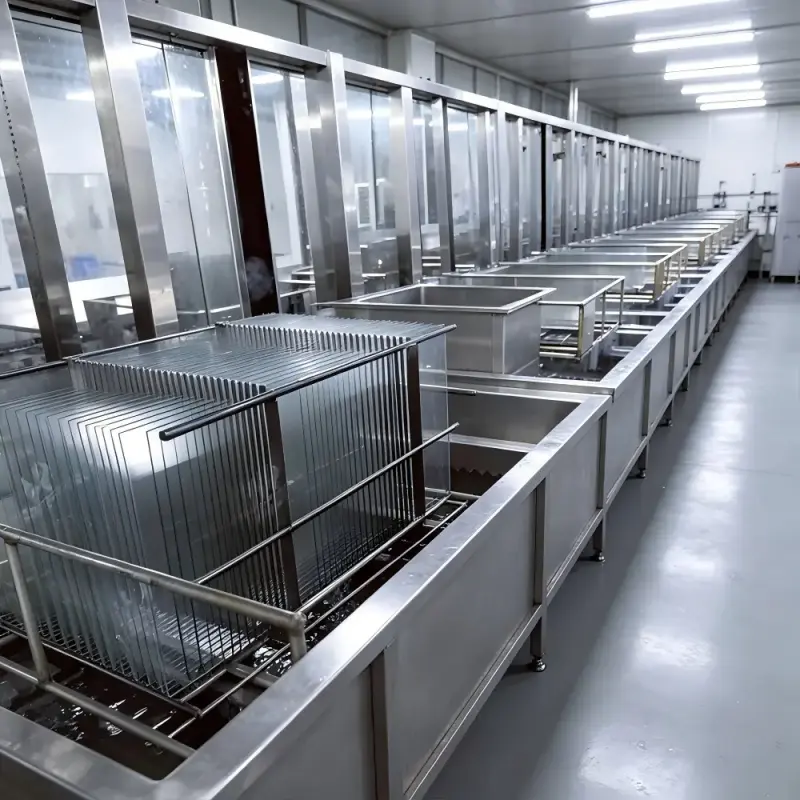
Ultrasonic Cleaning Method
Ultrasonic cleaning works through the cavitation effect. When high-frequency ultrasonic vibration applied at usually 28 kHz or 40 kHz, bubbles form within the cleaning liquid. As these bubbles expand and then implode, they generate localized pressure and micro-jets that help lift contamination away from the glass surface.
This approach is highly effective at removing polishing powder, oil contamination, adhesive residue, fine particles, and fingerprints, particularly in hard-to-reach areas such as edges, holes, and gaps. When used together with alkaline solutions and surfactant, the loosened contaminants can be carried away and filtered out of the system.
Ultrasonic cleaning is generally better suited for:
- Small-sized products
- Polished glass products
- Thin cover glass under 2 mm
- Applications requiring higher surface cleanliness
To prevent scratches caused by the cleaning process, the ultrasonic tank should be inspected daily for broken glass or other foreign objects. When replacing the water, the tank walls should also be cleaned thoroughly.
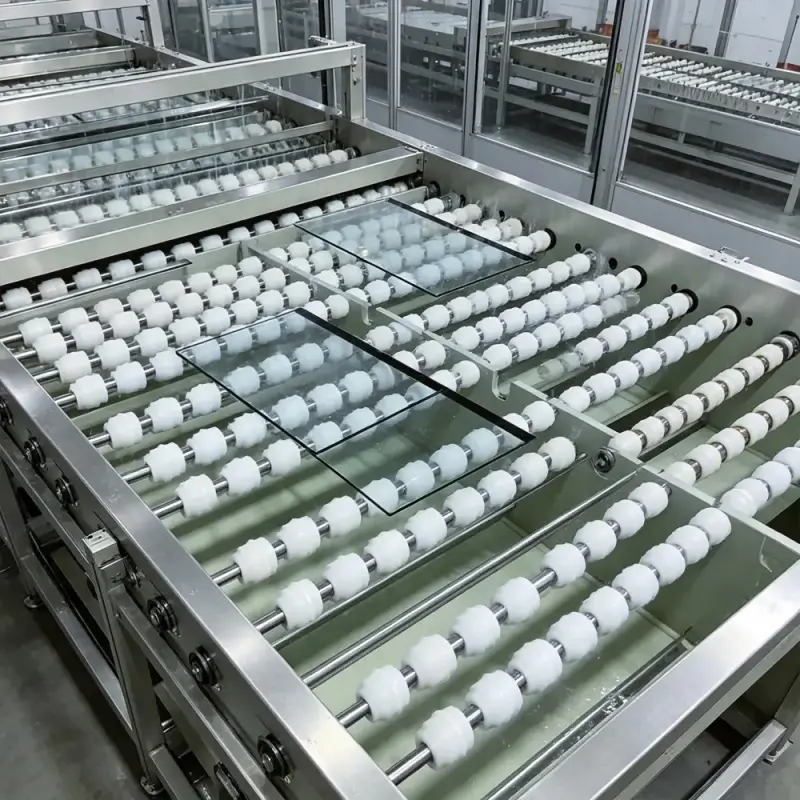
Flat Brush Water Cleaning
Flat brush cleaning combines mechanical brushing with continuous spray rinsing. As the glass travels through the equipment, soft brushes positioned above and below the surface work simultaneously to help remove larger particles and heavier surface contamination.
This method is effectively eliminate large dust particles, coarse polishing powder, thick oil film and floating debris from the glass surface. Spray rinsing with cleaning solution or pure water helps flush away loosened contaminants and reduces the risk of reattachment during the cleaning process. It is typically used as a practical pre-cleaning step ahead of finer cleaning stages.
Flat brush cleaning is generally more suitable for:
- Large size products
- Non polished glass products
- Higher output production
- Efficient line processing
A typical flat brush cleaning process may include alkaline brush washing, pure water brush rinsing, and air knife water removal with pre-drying, helping prepare the glass for the next production step.
In practical production, the most effective solution is often to use flat brush cleaning first for coarse cleaning, followed by ultrasonic cleaning for fine cleaning. This combination helps improve cleaning efficiency, reduce contamination load in the ultrasonic tank, extend filter life and support more stable production yield.
In general, small-size or polished glass products are more suitable for ultrasonic cleaning, while large-size or non-polished products are often better suited to flat brush cleaning.
How To Determine the Best Cleaning Approach for Each Project?
At Zilang, the cleaning method is chosen according to what the specific custom glass project actually requires. Our team takes the following factors into account:
Glass Thickness
This influences the choice of cleaning method, handling stability, surface protection, and process control requirements.
Panel Size and Shape
This influences the choice of cleaning method, handling stability, surface protection, and process control requirements.
Surface Quality Requirement
When higher surface standards are needed, tighter cleaning control is necessary to minimize particles, residue, and cosmetic defects.
Downstream Printing or Coating
The level of cleanliness must align with printing or coating requirements to support adhesion, consistency, and appearance.
Production Volume
The cleaning method should match the required output, striking a balance between surface quality, efficiency, and line stability.
Final Application Environment
The end-use conditions shape cleanliness expectations, appearance standards, and the selection of the process.
In Zilang, the options of cleaning base on product structure, contamination, downstream process sensitivity and production efficiency.
Request A Free Quote
We respect your confidentiality and all informations are protected
Contact Us
Send us a message if you have any questions, request a quote or free samples.Our experts will give you a reply within 24 hours and help you select the right cover/panel material as your request.
Phone
kimi@zlcoverglass.com
Address
ZILANG,DONGGUAN,GUANGDONG 523000,CHINA