
Tape Bonding
In Zilang, we offer precision tape bonding service offers post cover glass, excellent quality bonding with 3M™ adhesive.
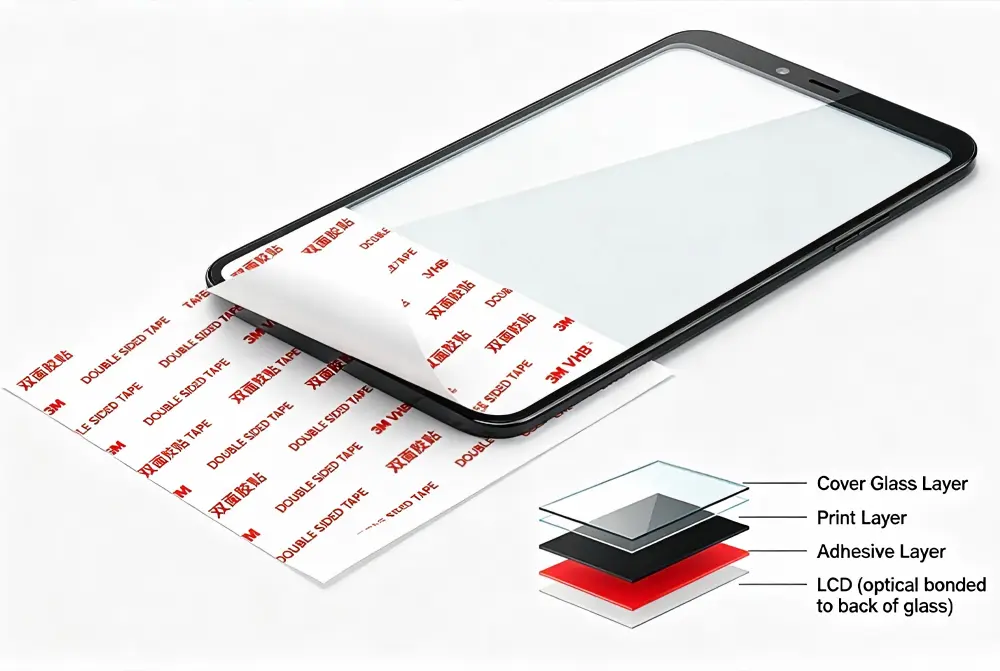
Tape Bonding
During cover glass production, the die-cut adhesive is applied around the glass edge inside a controlled clean room: a step that quietly decides how well the finished part later fastens to the device frame. What the customer gets back is a component that arrives ready to assemble: nothing trapped under the bond, no fixture time eaten up on their own line and a joint that holds as soon as it touches.
We’ve run this process for more than ten years. Instead of waiting for a drawing and cutting strictly to spec, we usually talk with customers while their product is still on the table asking about the housing material, the operating temperature range, the drop and torque tests the part has to survive and then suggest a tape family and a die/layout that actually fit those conditions, rather than forcing the design onto whatever happens to be sitting on the shelf.
The Tape Application Solutions
An adhesive joint is only as good as how it gets put down. Pick the right tape on paper, but apply it badly: misaligned, uneven pressure, a speck of dust caught between layers and the whole bond goes with it.
At Zilang our floor runs both hand-laid and fully automated tape application lines, which keeps us from pushing every job through the same tool. Small, complex, or first-run parts go through operators working under inspection, where judgment matters more than cycle time. Steady high-volume programs move onto the automated route instead, where tolerance holds tighter, unit cost drops, and the line keeps a pace a manual bench can’t match. We pick the route that fits the program rather than selling you whatever station happens to be free.
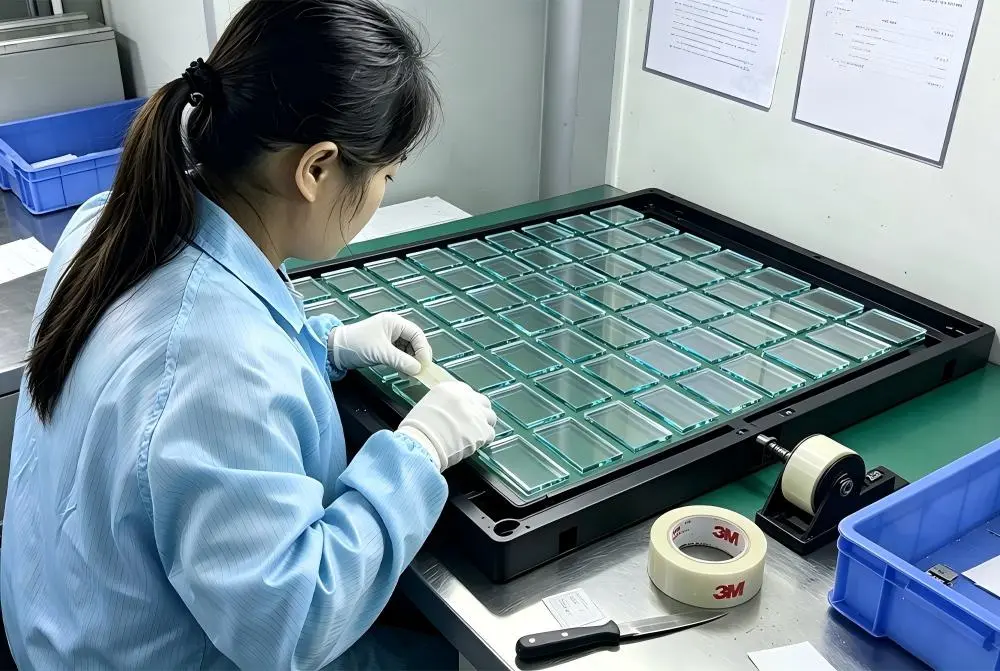
Hand Application, Run by Technicians
When a part is too large, oddly shaped, or simply not worth automating, it comes off the line and onto the bench. A trained technician lays the tape down by hand under inspection, no fixture, no program, no ramp-up.
What you get out of it:
- No size or geometry ceiling. Big backlit panels, curved covers, awkward compound shapes as long as a person can reach it, it can be taped.
- No tooling bill. Prototypes, engineering runs, and fifty-piece pilot orders don’t eat into your NRE, we start cutting the day the drawing lands.
- Fast to react. Revise the print on a Monday, parts off the bench by Wednesday.
Where it costs you:
- Throughput is what it is. A manual bench moves pieces per hour, not thousands per shift. This is not the route for a six-figure annual program.
- Quality walks in through the operator. A well-trained hand is repeatable, but the result still tracks back to the individual and the inspection loop around them not to a servo motor that puts down the same path a million times.
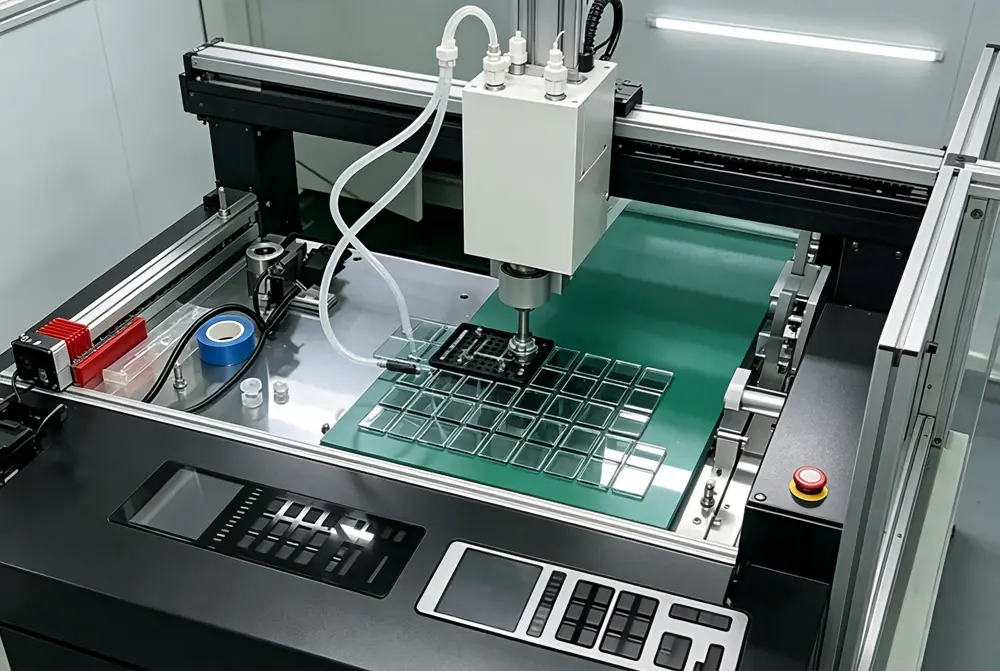
Machine Application, on the Automated Line
For programs that have earned the right to run on equipment, the tape goes down under servo control dispense heads, fixed fixtures, a program that plays back identically every cycle. This is where Zilang’s floor shifts from bench work into production.
What you get out of it:
- A bond that doesn’t depend on who’s clocked in. Position and pressure follow the same path every cycle; the CpK on placement you see on the first article is what every downstream unit holds to, not a moving target.
- Throughput that actually scales. Once the program is dialed in, parts move per minute rather than per hour. This is the route that makes a six-figure annual forecast pencil out.
- Fewer defects tied to human variation. Tape skewed by a tired wrist, pressure dropped at the end of a long shift, those failure modes largely go away replaced by an alarm when something actually drifts out of spec.
Where it costs you:
- The machine sets the size envelope. Anything outside the table travel, the reach of the head, or the pallet footprint doesn’t fit on this line, no matter how well-suited the part would otherwise be.
- Change isn’t free. A revised print usually means new fixtures, a tweaked program, and a first-article run before production resumes dollars and days on the calendar that a bench job wouldn’t have incurred.
The Tapes We Spec
The bond on a cover glass lives or dies by the material behind it without clean room, no precision dispensing, saves a poorly chosen tape. That’s why we standardize on a small set of premium acrylic foam bonding tapes rather than chasing every SKU in a catalog, and hold that system across programs.
Outdoor life measured in years, not seasons. The bond survives UV, humidity swings and the full thermal range a panel sees on a building facade or in a vehicle bay. Field data on our existing installs runs past ten years before anyone on the customer side raises a question.
Screws and rivets, gone. A continuous bond line replaces discrete fasteners, which is what lets the ID team hand you a seamless face no screw bosses, no witness marks, no torque spec on the back.
A gasket that doesn’t need a gasket. The tape itself seals water and dust ingress around the perimeter, so the enclosure doesn’t have to carry a separate rubber part to do the same job.
It moves when the materials move. Shock, drop, vibration, and the day-in-day-out CTE mismatch between glass and an aluminum or magnesium frame, the foam core takes up the strain instead of translating it into a peel line at the glass edge.
Sticks to what it has to. We’ve run qualification on aluminum, stainless, glass-filled composites, and the low-surface-energy plastics (polyolefins, powder-coated finishes) that usually make adhesives apologize.
One family, the full range. From sub-mil optically clear bonds under a cover lens to the thicker structural sections that take a drop test, we spec within one system, so the supply chain, the test data and the rework procedure all line up.
Regular Used 3M™ Tapes for Cover Lens Applications
| Part No. | Thickness (MM) | Color | Introduction | Heat Resistance | Part No. | Thickness (MM) | Color | Introduction | Heat Resistance |
|---|---|---|---|---|---|---|---|---|---|
| Y4914 (VHB) | 0.25 | Transparent | Structural Bonding, Waterproof | Short Term: 180℃ Long Term: 150℃ | 5915 (VHB) | 0.4 | Black | Structural Bonding, Waterproof, Soft | Short Term: 149℃ Long Term: 121℃ |
| 4920P | 0.4 | White | Structural Bonding, Waterproof | Short Term: 150℃ Long Term: 90℃ | 4905 | 0.5 | Transparent | Structural Bonding, Waterproof | Short Term: 120℃ Long Term: 80℃ |
| 4930P | 0.64 | White | Structural Bonding, Waterproof | Short Term: 149℃ Long Term: 90℃ | 4936 | 0.64 | Grey | Structural Bonding, Waterproof | Short Term: 149℃ Long Term: 93℃ |
| 5925 (VHB) | 0.64 | White | Structural Bonding, Waterproof, Soft | Short Term: 149℃ Long Term: 121℃ | 5952 (VHB) | 1.1 | Black | Structural Bonding, Waterproof, Soft | Short Term: 149℃ Long Term: 120℃ |
| 467MP (Thinnest) | 0.06 | Transparent | Heat Resistant, No Substrate, | Short Term: 260℃ Long Term: 149℃ | 468MP | 0.13 | Transparent | Heat Resistant, No Substrate | Short Term: 260℃ Long Term: 149℃ |
| 9488HK | 0.14-0.15 | White | Heat Resistant, Cotton Paper Substrate | Short Term: 120℃ Long Term: 80℃ | 9488A | 0.14-0.15 | White | Heat Resistant, Cotton Paper Substrate | Short Term: 120℃ Long Term: 80℃ |
| 55260B | 0.15 | Black | PET Substrate | Short Term: 149℃ Long Term: 121℃ | 93015LE | 0.15 | Transparent | PET Substrate, LSE Bonding | Short Term: 149℃ Long Term: 93℃ |
| 93020LE | 0.2 | Transparent | PET Substrate, LSE Bonding | Short Term: 149℃ Long Term: 93℃ | 7957MP | 0.18 | Transparent | Polyester Film for Membrane Panels | Short Term: 120℃ Long Term: 80℃ |
| 9473PC | 0.25 | Transparent | Heat Resistant, No Substrate | Short Term: 260℃ Long Term: 149℃ | 300LSE | 0.17 | Transparent | High-strength LSE & powder coat bonding | Short Term: 93℃ Long Term: 149℃ |
| The standard recommendation for bonding cover glass is the 3M™ VHB™ family of tapes for waterproof. | |||||||||
Tape Bonding In Cover Glass Challenges & Solutions
Enough generalities. The jobs below are real work we’ve run: a panel that started weeping after two winters outside, a frame that had to sit flush without a single fastener, a housing that kept delaminating on the drop rack. Each one follows the same arc: read what actually failed, pick the tape and the fixture that fits, run first articles, then hand over a process that survives production rather than a one-off sample.
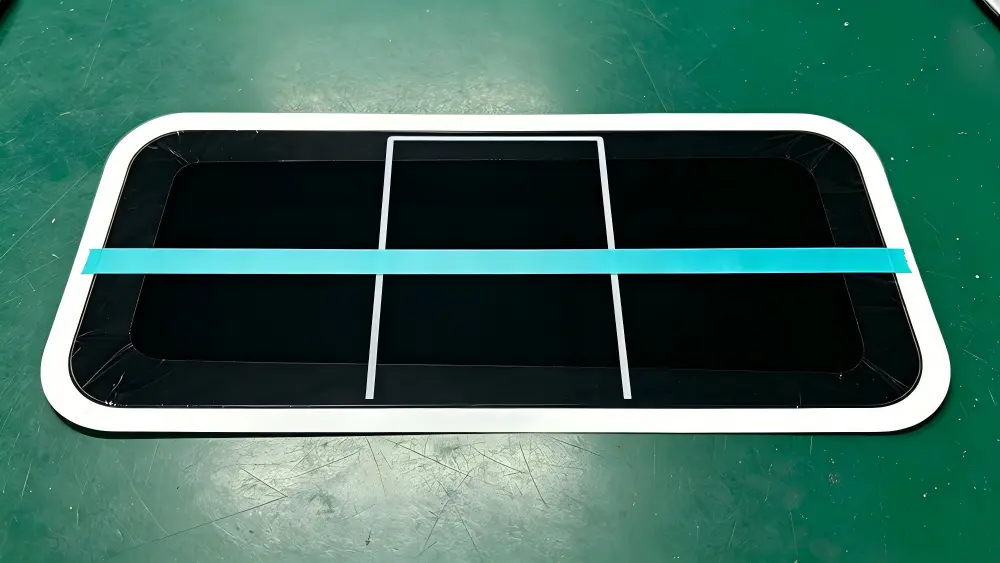
Panels Too Big for the Standard Line
The job was a 75-inch cover for a freestanding kiosk, the kind of glass that comes in on a furniture dolly, not a parts cart. Off-the-shelf applicators top out around 32 inches, so most shops fall back on hand-laying the tape. On a panel that size, “by hand” means one technician holding the corner while another chases a wrinkle across four feet of glass. By the time it reaches the customer, there’s usually a bubble sitting at the 10 o’clock edge and a 2 mm offset no amount of rework will fix. On a part that expensive, that’s an expensive problem.
We didn’t try to out-neat them by hand. Instead we built a process we call Lamination-Assisted Bonding: operators position the tape under optical inspection and tack it in place, no final squeeze yet. The panel then runs through a large-format laminator we modified for this work, whose pressure rolls bring the tape down at a controlled rate from one end to the other, sweeping air out ahead of them instead of trapping it. The bond line looks the same at the 60-inch mark as it does at the 1-inch mark.
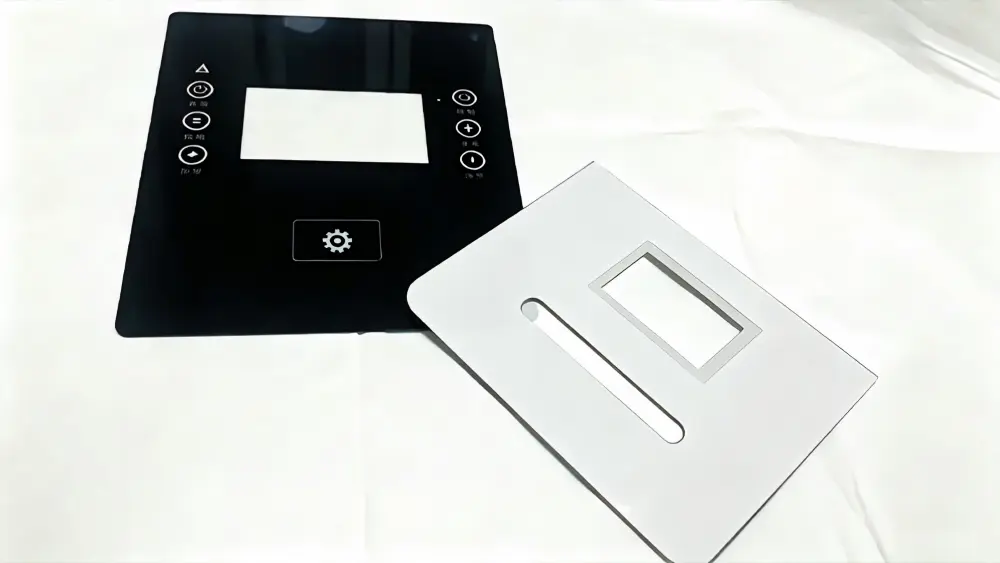
The View Area Has to Survive the Shop Floor
Two things kill a cover glass job before it ever reaches the customer’s device: a speck of dust sitting under the clear window and a bubble that shows up as a dark spot in the bond line. Either one sends the part to the rework bin. On a high-volume line, the two together turn what should be a stable process into a nightly fire drill yield numbers that bounce around, costs that don’t and engineering chasing a defect that shows up Tuesday but not Monday.
We attack them as two separate problems, because they have two separate root causes.
The first is dust in the optical zone. Once the clear area is open, every transfer, every fixture put-down, every operator reaching across the panel is a chance to leave a mark we can’t wash out after lamination. Our Protected Viewing Area technique keeps that window masked and sealed from the first cut to the last inspection, the film comes off only at the very end under a clean hood.
The second is air trapped between tape and glass. Hand lay-down always leaves a pocket somewhere; the question is whether the customer’s eye catches it. We don’t lay the final bond by hand at all. The panel goes through the same Lamination-Assisted Bonding pass we use on the large-format jobs, with pressure rolls sweeping the air out ahead of them. No trapped air, no dark spot, no rework.
Stack the two together and the defect rate stops being a forecast. It becomes a number we read off the SPC chart on Friday afternoon.
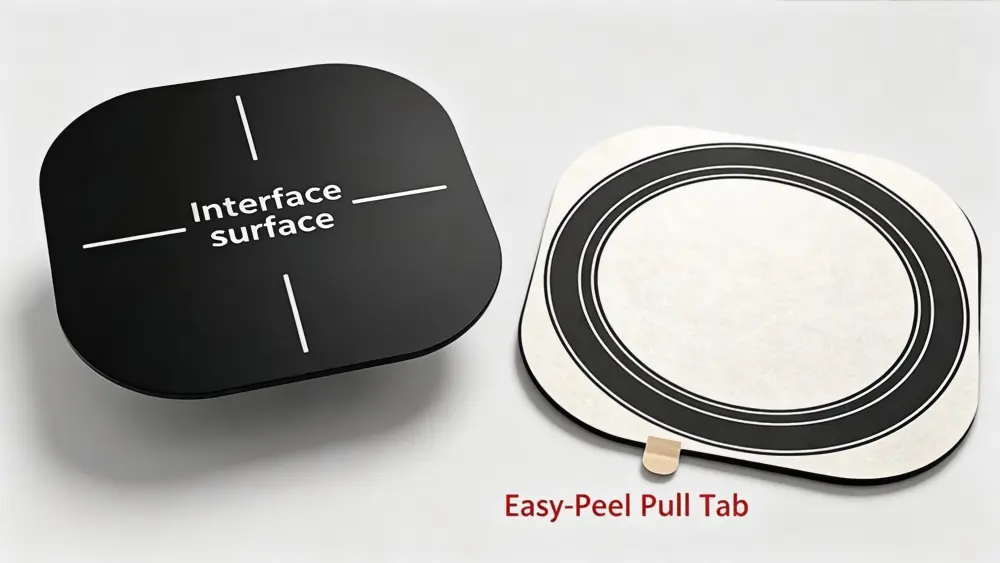
The Part Has to Survive Your Line, Too
We can hand you a panel that’s perfectly bonded inside our clean room. If your technician then spends forty seconds picking at the liner edge with a pick tool, scratches the glass trying to get a grip and drops a speck of contamination onto the frame before the part even reaches the adhesive, we’ve lost the job at our door, not at yours.
That’s why we don’t stop at our own line. As part of the DFM review, we spec the release liner with an integrated Easy-Peel Pull Tab: a small, indexed flap on the bond line that lands where an operator’s fingers naturally go. No pick tool, no razor, no “where do I grab?” on the customer’s side of the bench. One pull, liner off, part onto the frame cycle time drops and glass damage from fumbling with the backing disappears with it.
Why Zilang for Cover Glass Adhesive Bonding?
Cover glass bonding isn’t as simple as it looks. Contamination, material behavior, process variables get any one of them wrong and the whole component fails. That’s the reality most suppliers don’t talk about.
We do. Zilang was built around solving exactly these problems. Our team lives in the details:
keeping surfaces clean at a microscopic level
understanding how each adhesive behaves under real conditions and engineering processes that hold up in production, not just in the lab.The result,A bonded cover glass component that works the first time and every time after that.
Expert Adhesive Selection
Drawing on insights from hundreds of completed projects, we study your substrates and how the part will actually be used—then recommend the exact 3M™ tape to deliver a reliable, long-lasting bond.
Tight Tolerances, Absolute Precision
Our in-process quality controls are rigorous and unremitting. From raw material inspection to final verification, every panel is measured against your exact specifications—so you receive components that fit, function, and perform without deviation.
Disciplined Craftsmanship
Our technicians work by a simple philosophy: "Fast, Accurate, Decisive." This lean, focused approach to manual application gives every panel the precision and consistency you'd expect from an automated line.
Guaranteed Cleanliness in the Viewing Area
We tackle one of the most common causes of defects head-on. Our proprietary process shields the optical zone at every step of bonding, so it stays 100% free of dust and handling marks.
DFM Partnership to Prevent Failures
Our Design for Manufacturability (DFM) support covers the details that make or break a build: optimizing border clearances, PET reinforcement and stopping tape warping on flexible materials.
Bubble-Free Bonding on Any Size
When standard methods fall short on large glass panels, our "Lamination-Assisted Bonding" process applies calibrated pressure to deliver a guaranteed bubble-free finish.
Cost-Saving Solution
Source your cover glass and adhesive application from one expert partner, and you get a quality-inspected, assembly-ready component that shortens your path to market.
Request A Free Quote
We respect your confidentiality and all informations are protected
Contact Us
Send us a message if you have any questions, request a quote or free samples.Our experts will give you a reply within 24 hours and help you select the right cover/panel material as your request.
Phone
kimi@zlcoverglass.com
Address
ZILANG,DONGGUAN,GUANGDONG 523000,CHINA