
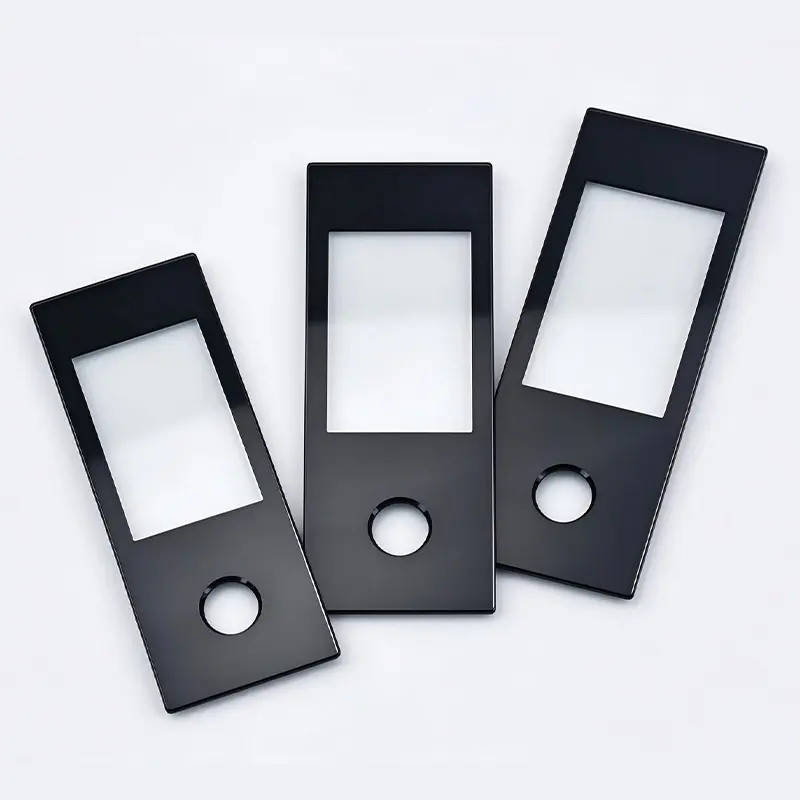
When designing glass components for industrial equipment, the glass panel is often required to do more than provide a transparent protective surface. Many applications need precise mounting features, such as drilled holes, slots, cutouts, or special edge profiles, to allow direct installation into a housing or mechanical structure.
A glass panel with mounting holes is commonly used in control equipment, electronic instruments, automation systems, smart devices, and customized user interfaces where accurate positioning and reliable assembly are important.
Unlike standard flat glass, these panels are manufactured according to engineering drawings. The hole locations, dimensions, edge conditions, glass thickness, and surface treatment must be considered together to ensure the final component fits the complete assembly.
Why Industrial Equipment Uses Glass Panels with Mounting Holes
Many electronic products require glass covers that can be fixed directly onto frames or enclosures.

Typical applications include:
Industrial Control Equipment
Industrial machines often use glass panels to protect displays, buttons, and touch interfaces.
Mounting holes allow the glass panel to be attached using screws, brackets, or mechanical fasteners without additional frames.
Common requirements include:
Precise hole positioning
Scratch-resistant surface
Chemical resistance
Durable edges
Stable dimensions after processing
Electronic Instruments
Measurement devices and testing equipment often require custom glass panels with specific openings.
The glass may include:
Sensor windows
Button openings
Connector cutouts
Indicator areas
Smart Control Panels
Modern control systems combine glass surfaces with touch technology.
Custom drilled holes and cutouts help integrate:
Touch displays
LEDs
Switches
Sensors
Decorative components
Key Design Factors for Glass Panels with Holes
Glass Thickness Selection
The thickness depends on the mechanical strength requirements and installation method.
Common thickness options include:
0.7mm
1.1mm
1.5mm
2mm
3mm
4mm
Thicker glass generally provides higher impact resistance, while thinner glass is preferred for compact electronic products.
Hole Diameter and Position Accuracy
Hole processing requires careful control because holes close to edges can affect glass strength.
Important drawing information includes:
Hole diameter
Hole-to-edge distance
Hole center position
Hole quantity
Tolerance requirements
For production projects, engineers usually review the glass drawing before quotation to confirm manufacturability.
Edge Processing Requirements
After drilling, glass edges normally require additional processing.
Options include:
Flat polishing
CNC edge grinding
Chamfering
Rounded corners
Proper edge finishing reduces stress concentration and improves handling safety.
Manufacturing Process of Custom Glass Panels
A typical production process includes:

Glass cutting according to drawing dimensions
CNC machining for holes and special shapes
Edge grinding and polishing
Chemical strengthening or tempering
Printing or coating if required
Cleaning and inspection
Each step affects the final appearance and assembly performance.
FAQ
What materials are available for glass panels with mounting holes?
Common materials include soda lime glass, tempered glass, aluminosilicate glass, and chemically strengthened glass. The selection depends on strength, thickness, and application requirements.
Can mounting holes be added to chemically strengthened glass?
Yes. However, hole machining is normally completed before chemical strengthening because post-processing may damage the strengthened surface layer.
What information is needed for quotation?
Manufacturers usually need a drawing showing glass size, thickness, hole dimensions, tolerances, surface requirements, and expected quantity.