
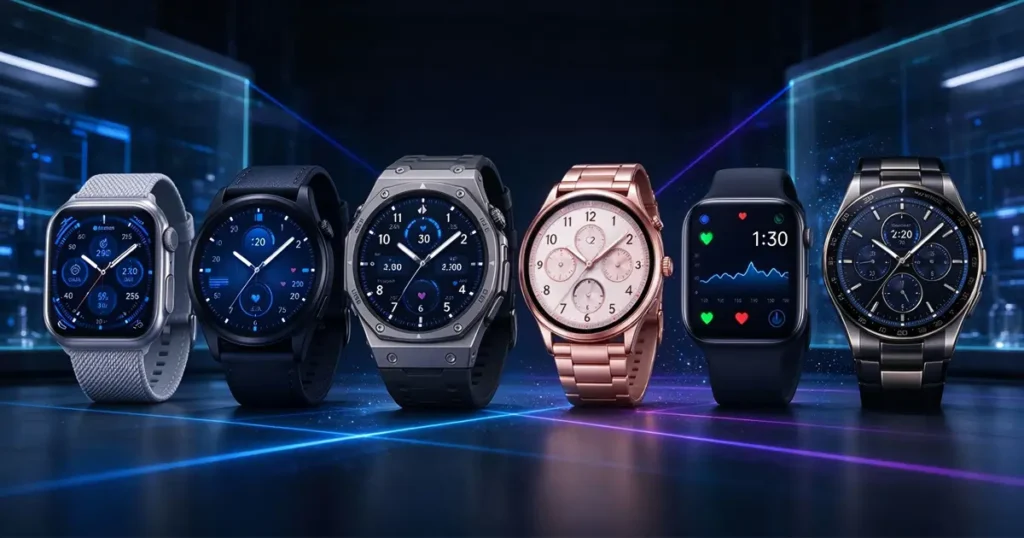
Choosing glass for a smartwatch display involves more than selecting a transparent material. The glass must fit a compact housing, meet the product’s appearance requirements and work with the display and touch-sensing structure.
For smartwatch brands, product designers and OEM purchasing teams, the right specification should be established before requesting samples or placing a production order. Material, thickness, shape, edge finishing and surface treatment all need to be considered together.
1. Select the Glass Material for the Application
Different glass materials offer different combinations of mechanical properties, optical performance, processing characteristics and cost.
Soda-lime glass may be considered for projects where its properties and processing route meet the product requirements. Aluminosilicate glass may be evaluated when the design calls for a glass grade suitable for chemical strengthening and a thin display cover.
The choice should not be made from the material name alone. Buyers should compare the available technical data, strengthening options, optical requirements and intended use conditions.
If scratch resistance, impact performance or weight is a key design concern, specify the required performance and ask the supplier to identify the suitable material and validation method.
2. Confirm Glass Thickness Before Finalizing the Touch Design
Smartwatches have limited internal space, so glass thickness can affect both mechanical integration and touch performance.
A thinner glass may help a compact design, but it must still satisfy the mechanical requirements of the finished product. A thicker glass may provide a different structural response, yet can affect capacitive touch sensitivity depending on the sensor and the complete assembly.
There is no universal thickness that suits every smartwatch.
Before finalizing the specification, confirm:
The available space in the housing
The display and touch-sensor structure
The mounting or adhesive arrangement
The required mechanical performance
The dimensional tolerance and finished profile
For technical background, see Infineon’s guide to choosing cover glass for a touch sensor. It explains why glass material and thickness should be considered alongside touch-sensor performance.
3. Match the Glass Shape to the Housing
Smartwatch displays may use round, square, rectangular or rounded-corner outlines. Some designs also require a specific edge profile or a shaped perimeter to match the enclosure.
A supplier should work from a dimensioned drawing whenever possible. The drawing should identify the outside dimensions, corner radii, glass thickness, edge treatment and relevant tolerances.
Do not rely on a nominal diameter or width alone. Two glass parts with the same main dimensions may still differ in corner geometry, edge profile or mounting fit.
If the glass will be bonded to a display module, the usable bonding area and surrounding housing should also be checked during design review.
4. Decide Whether Printing or Surface Treatment Is Needed
Some smartwatch designs use a black border or printed decorative area to conceal the housing or adhesive. Others require a clear appearance across most of the display.
Optional surface treatments may include:
Anti-fingerprint (AF): considered when reducing visible fingerprints is important.
Anti-reflective (AR): considered when reflections need to be reduced.
Anti-glare (AG): considered when a matte viewing surface is required.
These treatments perform different functions and should not be treated as interchangeable. Their suitability depends on the glass material, display design, visual targets and manufacturing process.
For printed glass, provide the artwork and clearly identify the printed side, transparent windows and any areas that must remain clear. The final appearance should be checked against an approved sample.
5. Check Touch Compatibility on the Complete Assembly
Glass is only one layer of a smartwatch display. The sensor, adhesive, display module and mechanical structure also influence the final performance.
A glass specification that looks suitable on paper does not automatically guarantee satisfactory touch response. The assembled design should be evaluated for touch sensitivity and normal operation.
For OEM projects, share the relevant sensor or module information with the glass supplier whenever it is available. This helps the engineering team assess whether the proposed thickness, printing and surface treatment are compatible with the intended structure.
6. Prepare the Right Information for a Supplier Quotation
A clear request for quotation helps reduce unnecessary exchanges and makes supplier comparisons more meaningful.
Include the following information where available:
If the design is still at the development stage, send the current drawing first and identify which specifications remain open for discussion.
Glass dimensions and thickness
Material preference
2D drawing or CAD file
Edge profile and dimensional tolerances
Printed border or logo artwork
Required surface treatment
Prototype quantity and estimated production volume
Packaging requirements
Required inspection or performance criteria
Conclusion
Selecting smartwatch cover glass is a coordinated design decision. Material, thickness, shape, edge finishing, printing and touch compatibility should be reviewed as part of the same project rather than specified independently.
For a custom smartwatch glass project, view our Smartwatch Cover Glass product page and prepare your drawing and target specifications before requesting a quotation.
Need a custom glass part for a wearable device? Send your drawing, target quantity and application requirements to discuss the next steps for an OEM project.