
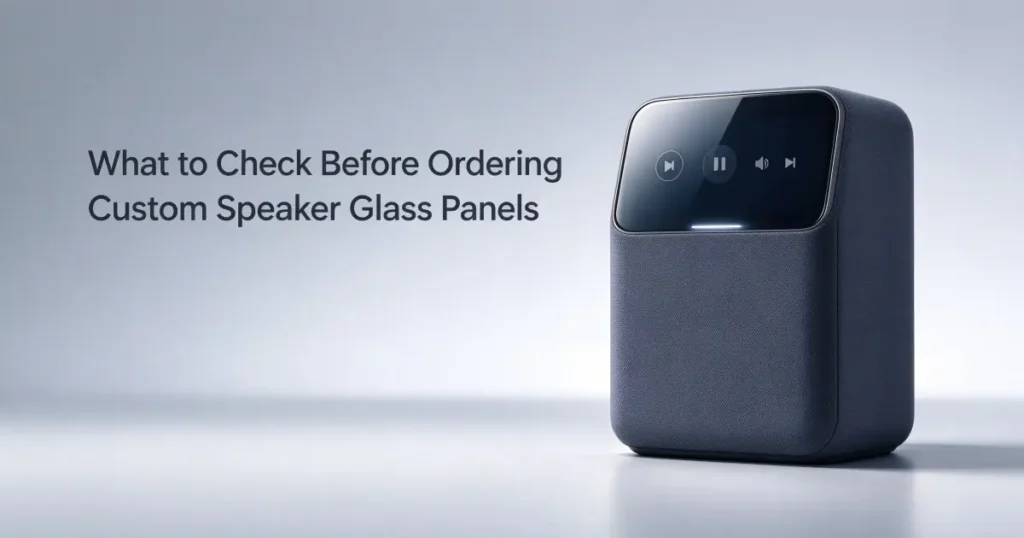
A glass panel on a speaker can serve several purposes. It may provide a finished front surface, carry printed control symbols, cover an indicator area or form part of a capacitive touch interface.
For smart speaker manufacturers and audio equipment brands, problems often arise when the glass drawing does not fully reflect the finished assembly. A panel may have the correct outside dimensions but still require changes to its printed areas, openings, mounting position or touch-control layout.
Before ordering custom speaker glass panels, review the following points with your supplier.
1. Define the Panel Outline and Mounting Structure
Start with the glass outline and the way it will be installed.
Some speaker designs use a flat rectangular panel, while others use a rounded profile or a custom shape that follows the enclosure. The drawing should show the overall dimensions, corner radii, thickness and any required edge treatment.
Also confirm how the glass will be mounted. Adhesive bonding, a retaining frame and other mounting structures can require different edge clearances and contact areas.
If the glass fits into a molded housing, check the relationship between the glass perimeter and the housing opening. Do not assume that the visible panel dimensions alone define the complete part.
2. Mark Every Printed Area and Transparent Window
Speaker glass may carry a black border, brand logo, icons or other decorative graphics. Some designs also include transparent areas for indicator lights or display elements.
These features should be identified clearly in the artwork or technical drawing.
For example, a printed area that extends too far into an indicator window can affect the appearance or visibility of the light beneath it. A logo or control symbol may also need a defined position relative to the enclosure.
Before production, confirm:
The required ink colors
The print side
The position of logos and control icons
The dimensions of transparent windows
The boundaries between printed and unprinted areas
The appearance standard for sample approval
Provide vector artwork where possible and identify the drawing revision used for quotation. This reduces the risk of different teams working from different versions.
3. Identify Openings and Cutouts Early
Some audio products require openings for mechanical controls, connectors or other components. These features should be shown on the drawing with their dimensions, locations and relevant tolerances.
Opening geometry can influence the manufacturing process and the strength of the finished glass part. Small openings, narrow glass sections and features close to the edge deserve particular attention during drawing review.
If the design does not require a physical opening, do not add one simply because a control or indicator appears on the front surface. Printed graphics and transparent windows are different from actual holes or cutouts.
The supplier should review the intended geometry before confirming manufacturability.
4. Check Compatibility With Capacitive Touch Controls
A glass panel may act as the cover for capacitive touch controls. In that case, the glass must be evaluated as part of the electronic assembly.
Touch performance can be affected by glass thickness, sensor layout, adhesive, air gaps and printed areas. The selected touch controller and the design of the complete module also matter.
A panel that looks correct when unpowered may behave differently once assembled with the sensor and enclosure.
For this reason, define the intended touch areas and evaluate touch response using the actual assembly structure. If the project includes touch controls, provide the sensor or module information to the engineering team where possible.
For additional technical background, see NXP’s guide to selecting cover glass for a touch sensor.
5. Select the Surface Finish for the Intended Use
The surface finish should reflect the product’s appearance and operating conditions.
Clear glass may suit a glossy, high-contrast front panel. A matte finish may be considered when visible reflections are a concern. An anti-fingerprint (AF) treatment may be considered when users frequently touch the surface, while anti-reflective (AR) treatment may be appropriate for specific optical requirements.
These options should be evaluated individually. A matte finish is not the same as an anti-reflective coating, and an AF treatment does not automatically eliminate fingerprints.
If the panel combines printing and surface treatment, confirm process compatibility and the required visible appearance before production.
6. Agree on Sample Approval and Inspection
A drawing review is an important first step, but it does not replace sample evaluation.
For an OEM speaker glass project, sample approval should cover more than the outside dimensions. Depending on the design, the review may include:
Outline dimensions and edge condition
Print position and color appearance
Alignment with the housing
Visibility of indicator windows
Surface appearance under the intended lighting
Touch response after assembly, where applicable
The inspection criteria and approved drawing revision should be agreed before mass production. This helps ensure that the production part is evaluated against the same requirements as the approved sample.
7. Prepare a Complete RFQ
A useful request for quotation should describe the part and its intended use.
Include the panel drawing, glass thickness, material preference, edge requirements, printed artwork, opening details, surface finish, prototype quantity and expected production volume.
If you have not finalized every specification, identify the confirmed requirements and the open questions separately. A supplier can then review the drawing and explain which details need clarification before pricing.
Conclusion
Custom speaker control panel glass requires coordination between the glass outline, housing, printed graphics, openings and electronic interface. Reviewing these details before sampling can help reduce design changes and improve communication between the buyer, designer and supplier.
For an OEM project, visit our Speaker Control Panel Glass product page to review the glass options and prepare your project requirements.
Planning a new speaker or audio product? Send your panel drawing, artwork and estimated quantity to request a project-specific quotation.